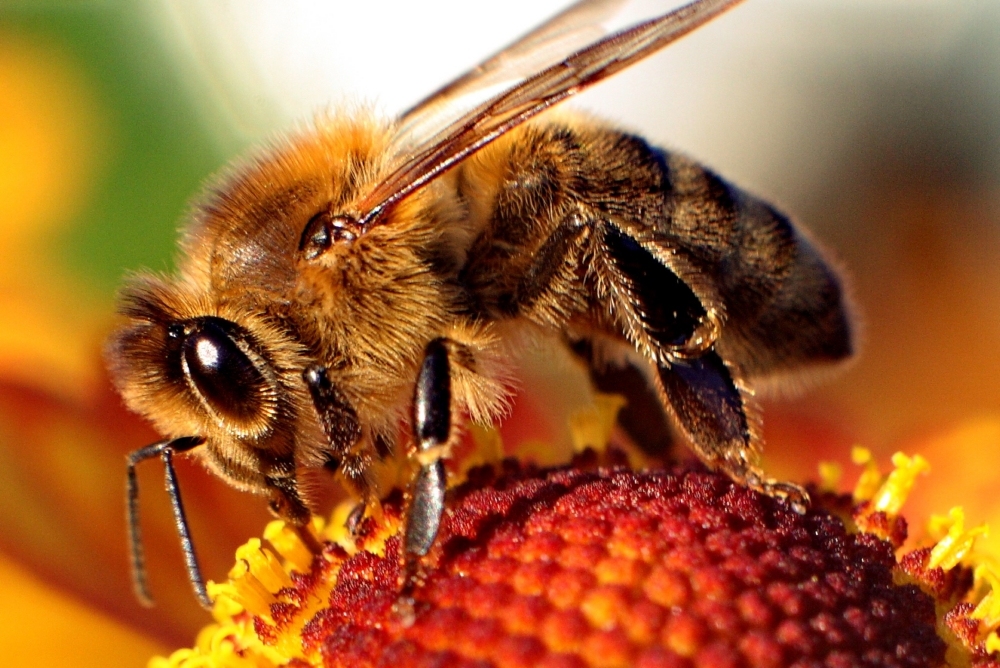
Title of Resolution: SOS for Honey Bees
Wording of Resolution:
SOS for Honey Bees – Honey Bees play a vital role in the pollination of food crops and in our environment.
In view of concerns about the accelerating decline in the UK honey bee population, this meeting urges HM
Government to increase funding for research into Bee Health.
Proposer’s position:
There is a general concern for the future of honeybees in the UK and globally, with threats from pests and disease that are threatening bee colonies. This resolution is seeking to address this decline with an increase in funding and support for the industry from the Government.
Outline of issue:
The decline of honey bees represents a major loss in biodiversity, as honey bees are not only responsible for producing honey, but play a vital role in pollinating plants for food and other crops. Approximately a third of our human diet is directly dependent on bees, making them central to our existence. In the natural environment, bees are also responsible for pollinating around 90% of the wild plants which produce seeds and fruits on which birds and wild animals depend, thus making them even more central to our world’s existence.
Bees were declared the world’s most invaluable species in an Earthwatch debate in November 2008 for their contribution to pollinating crops and plants. In a recently published book (see ‘for further information section) entitled A World Without Bees, the authors stated that: “if the bee disappeared off the surface of the globe then man would only have four years of life left.” Without bees to pollinate the plants that mankind and animals rely on, many experts believe we would quickly struggle to feed our population.
Currently, honey bees are coming under threat from pests and diseases for which treatments are not fully understood or are ineffective. Many bee keepers have experienced the complete destruction of their hives from such diseases, whilst the UK is losing its bee population at around 30% a year (up from just 6% in 2003).
The UK has 250 species of bees, three of which have already become nationally extinct. The then farming minister, Lord Rooker, admitted in Parliament in November 2007 that he fears the bee will be gone within 10 years.
Defra completed its consultation on Bee Health in January 2009 and announced that new resources would be allocated to fund the implementation of the Bee Health Strategy. The National Bee Unit currently gets £1.3 million a year. The new money will give the Unit an extra £2.3 million by 2010/11. An extra £400,000 is also being provided for research for each of the next five years.
However, the British Bee Keeping Association believes that this is not enough. It is calling for an £8 million research programme to run over five years to protect honey bees and stop the continuing decline. It argues that this is a small price to pay for the approximately £165 million which bees provide every year for the UK’s economy.
Wales angle
The Bee Health Programme is funded in Wales by the Welsh Assembly Government (WAG). £280,000 is provided annually by WAG to the National Bee Unit and £30,000 of additional funding has been given to carry out research and development.
Points to consider
This is a timely issue, with bee populations declining all over the globe. The USA has already seen devastating reductions in bee colonies and has experienced a number of additional diseases not yet seen in the UK.
Bees are crucial to the maintenance of a balanced and thriving ecosystem. Without bees, many flowers and plants cannot be pollinated, resulting in massive plant species loss. A bee campaign would therefore also be about the care of our natural environment.
Bees are central to humans’ existence, as well as that of our natural environment.
This could form a number of practical local campaigns, as well as a high profile national campaign.
There are many opportunities for members to learn about bees, as well as learn how to care for them or even become bee keepers themselves.
The British Bee Keeping Association (BBKA) has criticised Defra’s strategy. Despite recent announcements committing more money from Defra for bees and bee health research, BBKA are concerned that the commitment does not go far enough and will not have the desired impact. They estimate that £8 million over the next five years will need to be committed to this research programme.
The Government is acting on the issue. The Government has just completed its consultation on funding
for bee health research and new monies have been committed. Additional funds are being provided for research and to support the National Bee Unit.
Honey bees are not the only pollinators at risk. There are roughly 200,000 varieties of animal pollinators in the wild, most of which are insects. These include bees, wasps, ants, beetles, moth, butterflies, flies, hummingbirds, sunbirds, spiderhunters, honeyeaters, and fruit bats. Many of the traditional pollinators are in decline as a result of over-use of pesticides and other modern farming practices (such as monoculture, where one crop is grown exclusively across a large area), and the removal of natural habitats (such as hedgerows around fields). This is not a problem which is unique to bee populations and deserves investigation more broadly across all species.
There are a significant number of existing campaigns on the plight of the bee. The issue has been put on the agenda by others already.
Existing campaigns on the issue:
The British Bee Keepers Association runs a campaign called Honey Bee Health at Risk calling on the Government to increase the funding for bee health research. This campaign appears to have created awareness and is very likely to have contributed to the Defra announcement in January of further funding.
The Bumblebee Conservation Trust runs an awareness campaign called Bumblebees in Crisis, which provides practical information for individuals to support bees in their gardens.
The Co-operative Group is running a campaign called Plan Bee. It has contributed £150,000 for bee research, has implemented a pesticide ban as part of its ethical policy and has proposed a 10 point plan to save the bees
The British Science Association is running the Save Our Bees campaign as part of National Science and Engineering Week (starting 6 March 2009). This is sponsored by Rowse Honey which has also put up research funding.
Operation Bumblebee is a campaign to encourage farmers to put the habitats which will support and encourage bee populations back into Britain’s fields. It provides practical advice about how to do this, as well as seed packs and helps farmers understand the ecological as well as financial sense of this action.
How the WI could campaign on this issue:
Nationally the WI could:
Raise awareness about the importance of honey bees and the need for more investment in research.
Educate members on bee keeping, to encourage more people to become bee keepers.
Look at the possibility of linking up with food producers and manufacturers who rely on bees for their products, including work on promoting sustainable food.
Hold broader environmental and ecological educational events, looking at the way in which bees fit into the UK’s natural environment.
Locally WIs could:
Hold bee awareness talks at local WIs, from experienced bee keepers and others.
Encourage members to plant bee-friendly plants and record the uptake by bees over the seasons.
Lobby MPs to support local bee keepers and to put questions about support for bee research to the House of Commons.
Encourage local authorities, businesses and residents to plant bee-friendly flowering plants in gardens or in window boxes.
Work with local beekeepers and businesses to ensure that there is a local market for the honey produced, in order to help raise awareness of the plight of bees.
For further information:
BBC2 Its not easy being green (beekeeping section)
http://www.bbc.co.uk/iplayer/episode/b00gslmk/Its_Not_Easy_Being_Green_Series_3_Episode_2/
BBC2 Victorian Farm (beekeeping section) http://www.bbc.co.uk/programmes/b00hhns2
Trailer for the Hive Mentality film
http://www.hivementality.org/index.html
A World Without Bees, Alison Benjamin & Brian McCallum
Speech by Dr George McGavin at the Earthwatch debate
http://www.earthwatch.org/europe/newsroom/science/pages/news-3-result1.aspx?PageRefreshCount=1
Groups to contact for further information:
The British Beekeepers Association
The General Secretary
The National Beekeeping Centre
National Agricultural Centre
Stoneleigh Park
Warwickshire
CV8 2LG
Tel: 02476 696679
Bumblebee Conservation Trust
School of Biological & Environmental Sciences
University of Stirling
Stirling
FK9 4LA
http://www.bumblebeeconservationtrust.co.uk
Co-operative Group
Freepost MR9473
Manchester
M4 8BA
http://www.co-operative.coop/ethicsinaction/takeaction/planbee/
Defra
Customer Contact Unit
Eastbury House
30 – 34 Albert Embankment
London
SE1 7TL
Tel: 08459 33 55 77
Credits
bee image
By Maciej A. Czyzewski – Own work, CC BY-SA 4.0, https://commons.wikimedia.org/w/index.php?curid=8786717
 Eaten by Slugs
Leave a comment